
An export scope is a split of responsibilities, not a shipping quote. On a subscription box it looks unusual, because the same product leaves in small repeating parcels rather than one pallet, and the paperwork is refreshed on a cadence instead of assembled once. The split worth agreeing before the first dispatch covers four things: who classifies the goods, who holds the safety file, who books and insures the movement, and who is the importer of record. Everything else follows from those four answers, which is why they are worth an hour of someone's attention before the first carton is sealed.
Key takeaways
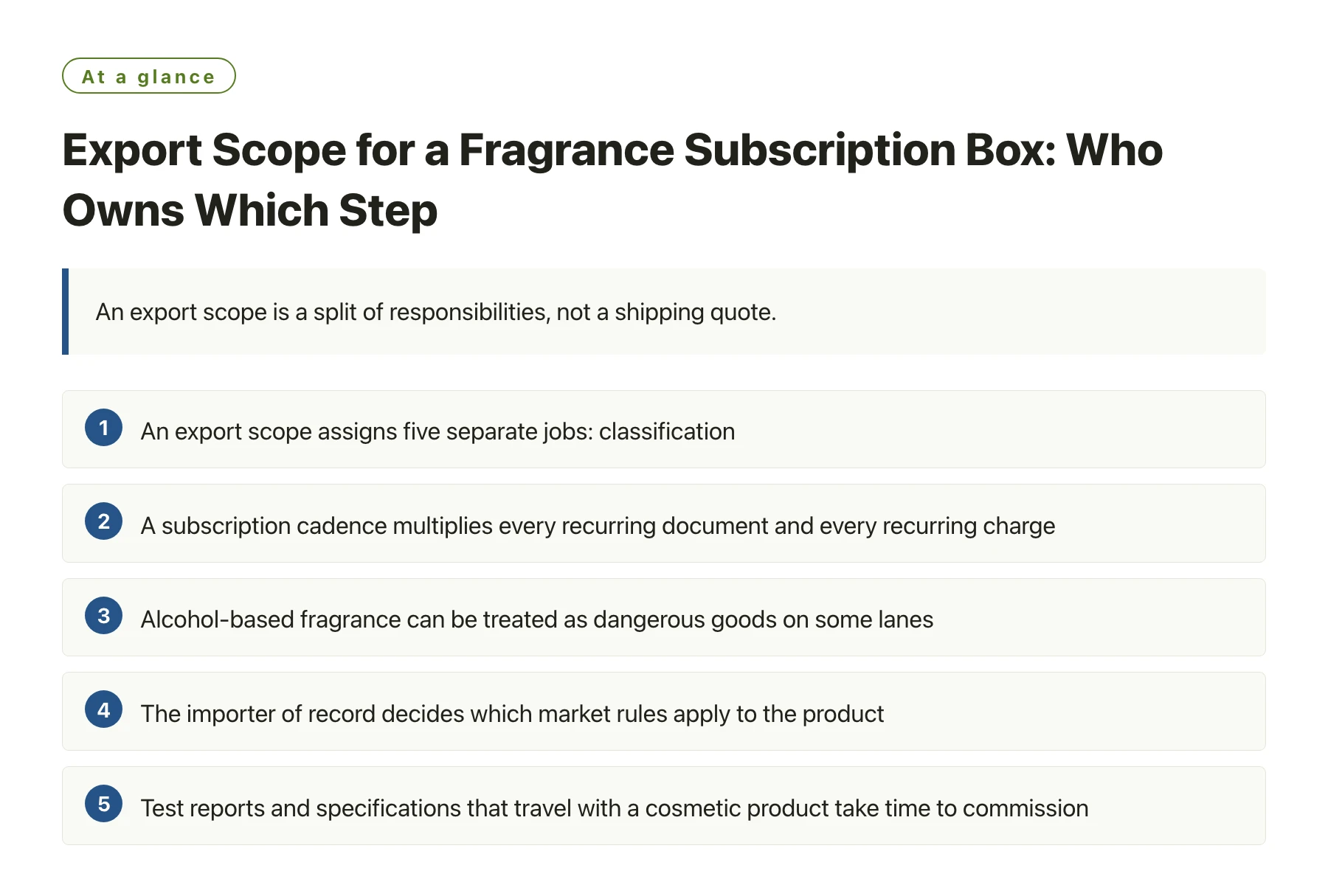
- An export scope assigns five separate jobs: classification, the safety file, freight and insurance, import clearance, and destination labelling.
- A subscription cadence multiplies every recurring document and every recurring charge, so each one needs a named owner rather than a default assumption.
- Alcohol-based fragrance can be treated as dangerous goods on some lanes, and forwarders will ask for a current safety data sheet and packing details before they quote.
- The importer of record decides which market rules apply to the product, which means the decision belongs before the first parcel rather than after the first clearance [1].
- Test reports and specifications that travel with a cosmetic product take time to commission, so they belong in the schedule as a scope item rather than as an afterthought [2].
- Most delayed dispatches are ownership gaps rather than freight problems, which is why the scope is best written as a table of steps with a name beside each one.
A subscription brand rarely ships the way a traditional fragrance launch ships. There is no single container to plan around, only a rhythm: the same box, in the same pack, leaving on a repeating schedule for as long as the subscriber list holds. That rhythm makes export simpler in one sense and harder in another. Simpler, because the product does not change much between dispatches. Harder, because anything that depends on paperwork has to survive being repeated every month without anyone relearning it.
The temptation is to treat the whole subject as the forwarder's job. Forwarders are good at moving goods and poorly placed to make commercial decisions on a brand's behalf. They will ask who the importer of record is; they will not decide it. They will ask for a safety data sheet; they will not commission it. The export scope is therefore not a description of the forwarder's work. It is the boundary between what the factory quotes, what the brand instructs, and what the forwarder executes.
Five decisions define that boundary on a subscription box. Each can be assigned in a single sentence, and each has a recognisable failure mode when it is left unassigned. The order matters, because classification and market rules shape everything downstream.
Five decisions that define an export scope
| Decision | What it settles | Who normally owns it | How it fails when unowned |
|---|---|---|---|
| Who classifies the goods | The customs code the shipment is declared under, and therefore the duty rate and the documentary requirements attached to it | Usually the exporter's broker, with technical input from the factory | A code is copied from a similar product and the duty or licence position shifts without anyone noticing |
| Who holds the safety file | Whether a current safety data sheet, specification and test reports can be produced on request, in the destination language if required | The factory for the base product, the brand for the finished retail unit | A forwarder asks for an updated sheet a week before dispatch and nobody owns the answer |
| Who books and insures the movement | Freight cost, transit time, and who carries the loss when a parcel disappears between two countries | The brand, unless the factory sells on delivered terms | Insurance is assumed to be inside the freight quote and turns out not to be |
| Who is the importer of record | Which market rules the product must satisfy, and who is legally answerable for them | The brand's local entity or a contracted service provider | Duties and labelling liability land on the brand by default at the first clearance |
| Who owns destination labelling | Allergen and ingredient declarations, language requirements, and any channel-specific listing rules | The brand, with technical data supplied by the factory | One artwork version is reused across markets until a retailer rejects it during listing |
None of these is difficult alone. They become difficult when two of them are unassigned and the first dispatch is a week away.
Classification is the decision the rest depends on
Before asking for a freight rate, ask how the goods have been classified before. A supplier that exports routinely can usually say which code its products travel under and which destinations have caused friction. When you ask this Chinese perfume manufacturer this Chinese perfume manufacturer to explain its usual classification, the answer tells you two things at once: whether export is a routine part of the operation, and whether the factory can supply the specification, safety data sheet and ingredient breakdown that the classification rests on.
Classification also determines which market rules attach to the shipment. A product placed on the market as a cosmetic carries obligations that are not the factory's to discharge: a responsible person established in that market, a product information file, and label text in the required language [1]. Those obligations sit with whoever places the product on the market, and that is normally the brand rather than the manufacturer. Settling this early is not bureaucracy for its own sake, because it decides whether the first dispatch is a shipment or a delay.
The safety file has a lead time of its own
Test reports and specifications are the part of an export pack that cannot be produced in an afternoon. Compatibility and stability work is commissioned, scheduled and paid for, and a manufacturer that fills and ships on a monthly cadence already has a testing rhythm that a new brand has to fit into [2].
For a subscription box the file also has to stay current. Ingredients change, artwork changes, and a data sheet that was accurate at launch may not be accurate twelve months later. The scope should say who refreshes the file and how often, rather than leaving it to whoever happens to be asked. Some brands keep a versioned folder with a named owner. Others discover the gap when a forwarder requests a current sheet and no one can produce one.
What belongs in the written scope
- A table of steps, not a paragraphEach step gets an owner, a document and a trigger date, so a stalled dispatch can be traced to a specific unowned step instead of becoming a general complaint.
- The trade-term lineName the term for the first three shipments and say who is expected to revisit it if the cadence grows into pallet volumes, because that change moves the economics of one-stop fragrance manufacturing one-stop fragrance manufacturing considerably.
- The document list with ownersSafety data sheet, specification, ingredient breakdown, allergen declaration, certificate of analysis, packing list and commercial invoice, each with the party that produces it.
- The recurring-cost lineFreight, insurance, clearance and any per-parcel handling charge, stated per shipment so the monthly unit economics can be modelled rather than guessed.
- The destination-rules lineThe market the product will be sold in, and confirmation that the arrangement reflects what that market asks of the party placing the goods on sale.
Matching the scope to a supplier's export habit
There is a quick way to test whether a supplier treats export as routine: ask for the last three destinations it shipped to and what changed in its paperwork for each. A house that exports regularly will have a story about a market that needed different allergen text or a lane that needed a different packing declaration. A house that exports occasionally will answer in generalities, which is useful information about how much of the scope you will end up carrying yourself.
The same question is worth asking of contract perfume manufacturing in China contract perfume manufacturing in China more broadly, because the answers vary more than the certificates suggest. Two suppliers can hold the same documents and still differ entirely in how much export administration they absorb. The one that absorbs it tends to make the difference between a predictable monthly dispatch and a monthly reminder of who forgot what.
A useful test of an export scope is dullness. Read it back and check whether every step names a company, a document and a trigger. If a step says that something will be handled, it is not yet a scope. It is a hope.
Sources
- European Commission: Cosmetics in the EU —— The European Commission's overview of EU cosmetics rules, including the responsible person, product information file and safety report requirements.
- SGS: Cosmetics, Personal Care & Household Testing —— Testing, inspection and certification services for cosmetics and personal care, including microbiological, stability and safety testing aligned with cosmetics GMP.
Frequently asked questions
Who should be the importer of record for a subscription fragrance box?
Usually the brand's own entity or a service provider it contracts, because placing the product on the market is what triggers most destination obligations. A factory can act in some arrangements, but that shifts liability in ways worth understanding before the first clearance rather than after it.
Should the factory or the brand arrange freight?
Either can work. What matters is that the trade term makes the split explicit and that insurance is not assumed on both sides or neither. For a repeating monthly shipment, brands often keep freight in their own hands so that the cadence and the cost stay visible.
Is fragrance always treated as dangerous goods?
Not always, and not uniformly. Alcohol content, pack size and the rules of the specific lane all play a part, which is why forwarders ask for a safety data sheet and packing detail before quoting. Treat the answer as lane-specific rather than universal.
How early should testing be commissioned for export?
Early enough that the reports exist before the first commercial dispatch, which usually means commissioning them alongside the packaging artwork rather than waiting for the first order. Repeats after a formula or pack change should be budgeted in advance.
What is the most common cause of a delayed first export?
An ownership gap rather than a freight problem. Two parties each assume the other is holding a document, and the gap only becomes visible when a forwarder or a customs broker asks for it.