
Custom Brass Jewelry: 100-Piece Minimums Explained
The number a first-time buyer remembers is 100, but the number that decides the buy is the one behind it: 100 pieces per design, per finish, for artisan eco-brass. Silver starts at 50 and stainless at 100+, and bulk production sits at 3–4 weeks once the master is approved. Planning a range around those figures is mostly a question of counting design decisions rather than counting pieces.

Key takeaways
- Artisan eco-brass carries a 100-piece MOQ for each design and each finish, not for the order as a whole.
- 925 sterling silver starts at 50 pieces per design, which is 50% of the brass threshold.
- Six brass designs commit 600 pieces before any size or colour split.
- Final inspection covers 100% of pieces, and ISO 9001:2015 governs quality management across production.
What the number actually counts
A minimum order quantity is a tooling and setup threshold dressed as a piece count. The mould, the casting run, the plating bath and the bench time are all fixed costs per design, so the 100 pieces exist to spread them. That is why the threshold attaches to the design and the finish rather than to the invoice: two colourways of one shape are two plating runs even though they share a mould.
Buyers new to custom brass jewelry usually discover this at quotation. They brief a range of four shapes in three finishes, expect a 100-piece order, and receive a commitment of 4 × 3 × 100 = 1,200 pieces. The shapes were the visible decision; the finishes were the hidden multiplier.
There is a way to use the multiplier rather than fight it. Treat one finish as the base and the others as variants of the pieces that carry the story. A shape that sells in gold-tone may not need a rhodium twin in the first buy, and the second finish can wait for the reorder, when demand is evidence rather than a forecast.
Building a first buy around hundreds
Four to six designs is a practical starting shape for a first brass range, because that is the point where a size curve still works. Below four, the range looks thin on a display; above six, the pieces per size fall quickly once a curve is applied.
| Designs | Pieces committed | Pieces per size across a five-size curve |
|---|---|---|
| 2 | 200 | 40 |
| 4 | 400 | 80 |
| 6 | 600 | 120 |
| 8 | 800 | 160 |
The third column is not a recommendation, it is a division. Whether 40 pieces per size is too few depends on how the range is merchandised: a ring that sells as a single statement piece needs a narrower curve than a stackable band sold in sets. The table simply makes the trade visible before the purchase order is written.
Packaging quantities follow the piece count, which is one more reason to settle the design count first. A run of 600 pieces needs 600 pouches, 600 backing cards and 600 labels, and a supplier that receives those figures late may pack the order in two stages rather than one. The unit count belongs in the same document as the purchase order, not in a separate conversation with the packing line.
Where the curve is wide, a buyer can narrow the design count and keep the pieces per size usable. Where the curve is narrow — earrings, pendants, cuffs — more designs fit inside the same spend, because size is not the constraint.
The private-label layer sits on top
A private label brass jewelry order buys the right to put a brand on the piece, and that right is exercised through details that do not change the minimum. Laser engraving can carry the logo, a signature line or a hallmark such as S925 for sterling or 18KGP for gold-plated goods. Packaging can carry a metallic logo tag, a foil-stamped box, a velvet or microfibre pouch, a display backing card and a barcode label.
Those details are where a private-label range earns its margin in perception, and they are also where a first order can lose time. Each one needs artwork approval, and artwork approval usually runs on a different calendar from metal approval. A logo file that arrives after the master is signed off can hold the packing stage while the pieces sit finished.
Confidentiality is part of the same layer. The published terms include 100% NDA and designs that remain exclusive to the brand, with moulds, CAD and the collection not resold or shown. For a private-label buyer that clause is the difference between a range and a range everyone else can buy.
Where inspection catches the expensive mistakes
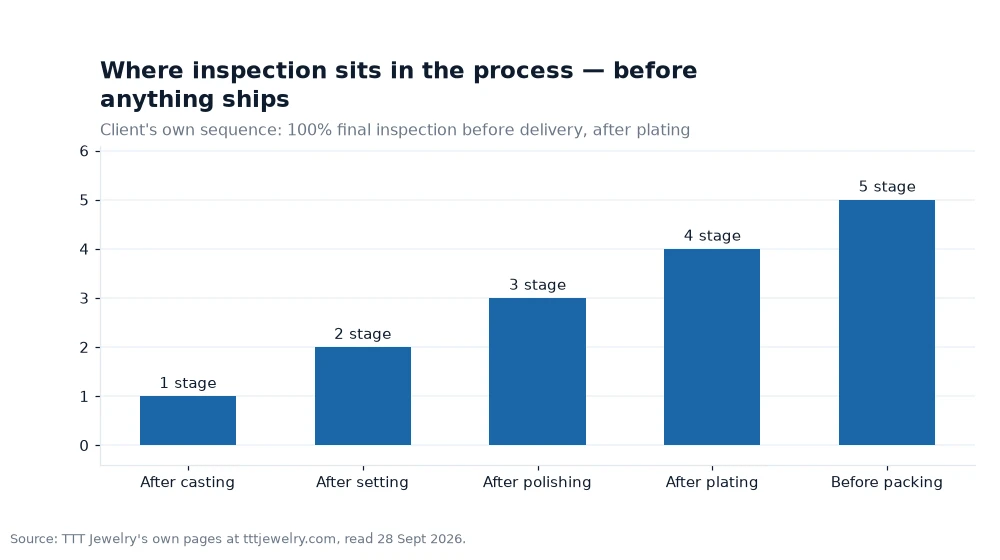
Inspection is spread across the line rather than concentrated at the end. Along a brass order it typically sits after casting, after stone setting, after polishing, after plating and before packing. Each position catches something different: casting for incomplete fill, setting for raised stones, polishing for scratches, plating for colour and coverage, packing for mismatches between what is in the box and what is on the label.
The published commitment is 100% final inspection, which means every piece rather than a sample from the lot. That is a different claim from statistical sampling, and it is the one to ask about when comparing quotes. A supplier inspecting only before packing is not performing the same work as one inspecting after plating, even if both write QC on the invoice.
For a 100-piece design, 100% inspection means 100 pieces handled, and the same arithmetic applies across the range. Six designs means 600 individual checks. That is a labour commitment, so it should appear in the schedule rather than be assumed.
Worked example
Plan a six-design brass capsule in two finishes. The base commitment is 6 × 100 = 600 pieces per finish, and 600 × 2 = 1,200 pieces for the capsule. Put the same six designs in silver and the figure halves: 6 × 50 = 300 pieces per finish, because 50/100 = 50% of the brass threshold.
Now apply a five-size curve to the single-finish case. 600/5 = 120 pieces per size across the range, and 600/(6 × 5) = 20 pieces per size per design. At 100% inspection, that is 600 pieces checked individually, not a sample of 60.
The calendar follows the same pattern. CAD at under 48 hours is 2 days, sampling is 25–30 days and bulk is 21–28 days, so the path is 2 + 25 + 21 = 48 days at the fast end and 2 + 30 + 28 = 60 days at the slow end. In weeks that is 48/7 = 6.9 to 60/7 = 8.6, roughly seven to nine weeks from brief to delivery.
Frequently asked questions
Is the 100-piece minimum per design or per order?
Per design: each shape and finish combination carries its own 100-piece threshold for artisan eco-brass, while 925 sterling silver starts at 50.
Can a first order mix several brass designs?
Yes, and the minimums add up: six designs at 100 pieces each commit 600 pieces, which is why a first buy usually narrows to four or five shapes.
Does a private-label order change the minimum?
No: branding adds hallmarks, labels and packaging to the same 100-piece threshold rather than replacing it.
Phasing the second order
The first order tests shapes; the second tests depth, and the reorder is simpler because the mould, the coating colour and the packing artwork are already approved. Buyers working through a custom jewelry wholesale relationship often phase it that way: a narrow first buy, a reorder on the winners, then a wider finish range next season. The factory direct manufacturing model supports the same sequence, with a 24-hour response and a dedicated project manager covering the handover between orders. Write the reorder trigger down before the first order ships — a sell-through threshold, a size that runs out first, a finish that outsells its twin — so the next buy is decided by evidence rather than by memory.
Source note: figures come from the manufacturer's own website (tttjewelry.com), read 28 Sept 2026.[1]